
 Deutsch
  English
  Français
  简体中文(中国)
 FAQ – Surface Finishing Technologies
Supfina stands for the highest precision in surface finishing, particularly in the areas of superfinishing, fine grinding, and double disk grinding.
In this FAQ section, you will find concise, easy-to-understand, and practical answers to the most important questions about our technologies, applications, and services. We are continuously expanding this section to provide you with new topics and the latest developments.

Superfinishing uses ultra-fine abrasive grains with randomly shaped cutting edges. Unlike turning or milling, the cutting geometry is not defined. According to DIN 8589 Part 14, the process is therefore classified as “machining with geometrically undefined cutting edges.”
In turning or milling, the tool has a precisely defined cutting geometry with specified rake angle, clearance angle, and wedge angle.
In superfinishing, however:
- many individual abrasive grains are active
- each grain has a random cutting geometry
- material removal occurs through micro-cutting
- multiple cutting edges engage simultaneously
This results in:
- very small chip thickness
- extremely low cutting forces per grain
- controlled material removal in the micrometer (µm) range
In machining processes such as grinding or hard turning, the surface layer of a workpiece can be affected by the heat generated and the mechanical loads applied during the process. This can lead to changes in the material structure near the surface and the development of residual stresses within the material. These changes are referred to as a “damaged surface layer” and can negatively impact the performance and load-bearing capacity of a component.
Superfinishing, in contrast, is a thermally neutral machining process. During the process, the tool is applied to the rotating workpiece surface with relatively low pressure and performs an oscillating motion. This method of machining does not damage the near-surface material structure.
Instead, superfinishing reveals the original microstructure of the material. At the same time, compressive residual stresses can form at the surface, which improve the functional performance of highly stressed components..

Superfinishing is a finishing process used to improve the surface structure and geometry of components. A key characteristic is the formation of a cross-hatch pattern—intersecting machining marks on the workpiece surface. This structure results from the superposition of different movements during processing and contributes to improved tribological properties.
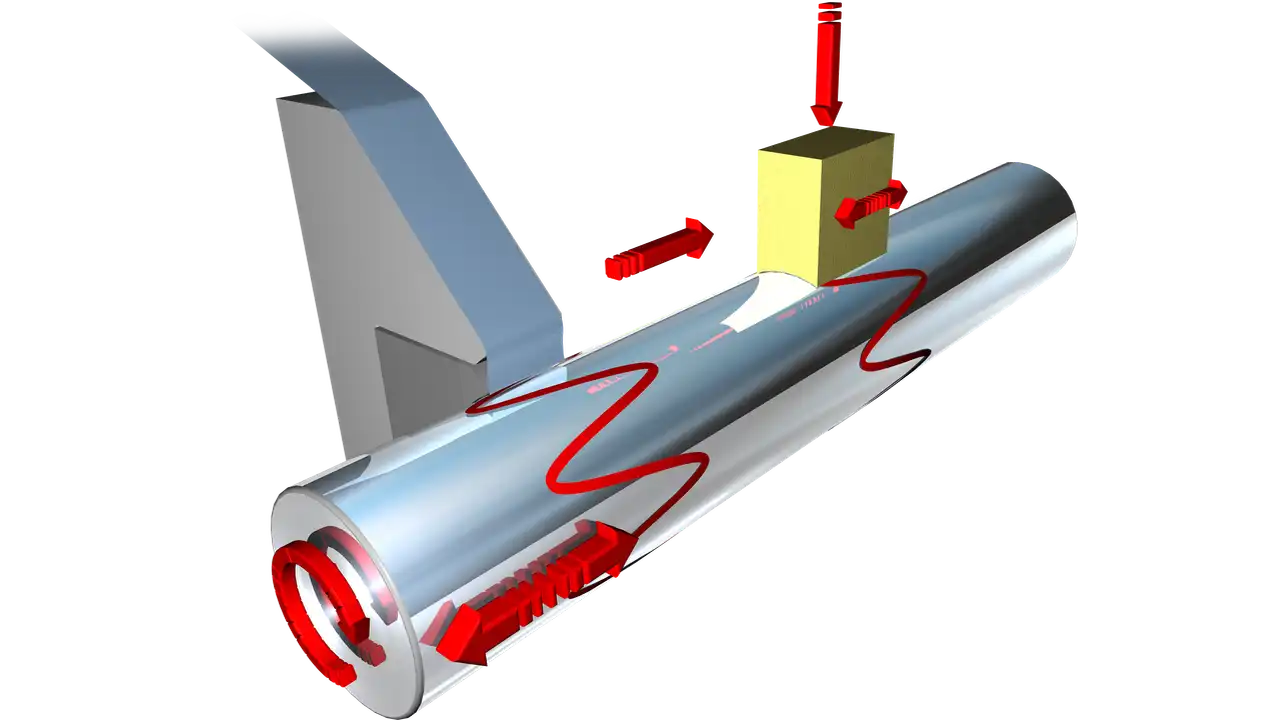
In conventional superfinishing, the workpiece rotates while the tool is pressed against the surface with a short oscillating motion. The ultra-fine abrasive grains within the tool move across the surface along a sinusoidal path. The combination of these motions produces the characteristic cross-hatch pattern. Tools used include superfinishing stones or abrasives on a flexible backing, known as superfinishing tapes. Material removal is minimal and primarily affects the peaks of the existing roughness profile.
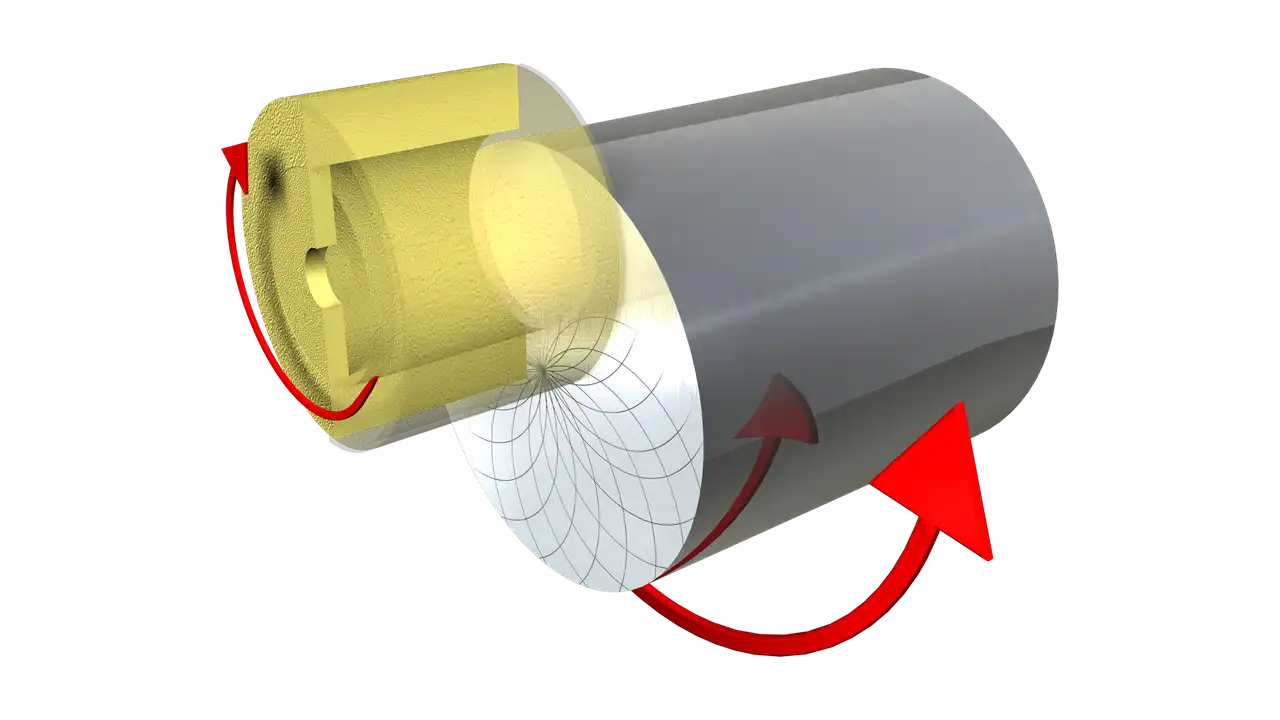
In addition, planar finishing—also known as cross-hatch superfinishing—is used. In this process, both the tool and the workpiece rotate. The rotating tool is pressed against the workpiece surface with a defined pressure. The overlapping rotational movements create arc-shaped machining marks that form a radial cross-hatch pattern. This process uses bonded abrasives such as cup wheels, sleeves, or segmented tools.
Both processes pursue the same goal: reducing surface roughness and increasing the load-bearing area. The result is a plateau-like surface structure that can retain lubricants, thereby reducing friction and wear during operation.
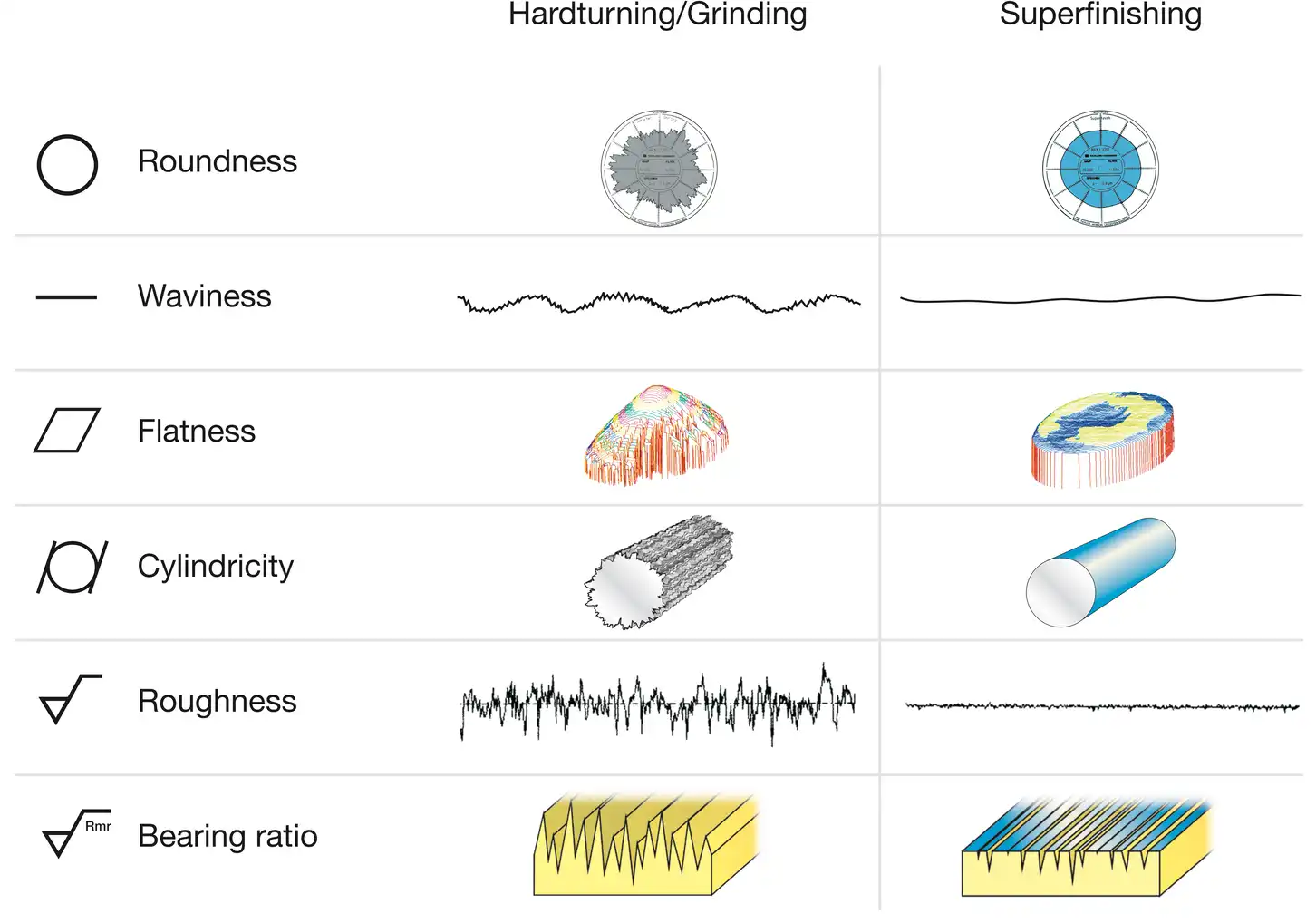
Superfinishing is typically used as the final machining step and is primarily intended to improve the surface structure and geometry of a component in a targeted way. While pre-machining processes such as turning or grinding produce relatively rough surfaces, superfinishing mainly removes the peaks of the existing roughness profile. This increases the load-bearing area of the surface and significantly reduces roughness.
A key outcome of this process is a plateau-like surface structure with intersecting grooves. This structure enables excellent fit between mating components. At the same time, the grooves can retain lubricants, improving the tribological properties of the surface.
This optimized surface structure provides several functional benefits. Wear between components is reduced due to lower friction. In addition, reduced friction leads to lower noise levels, which is particularly important for high-speed rotating components such as rolling bearings or engine parts. Furthermore, less energy is lost as frictional heat, which can help reduce overall energy consumption.
In addition to functional improvements, the superfinishing process also contributes to the economic optimization of manufacturing processes. Machining times are relatively short compared to other cutting processes, making it easy to integrate into existing production lines. Moreover, the tools used are often relatively cost-effective, making the process economically attractive.
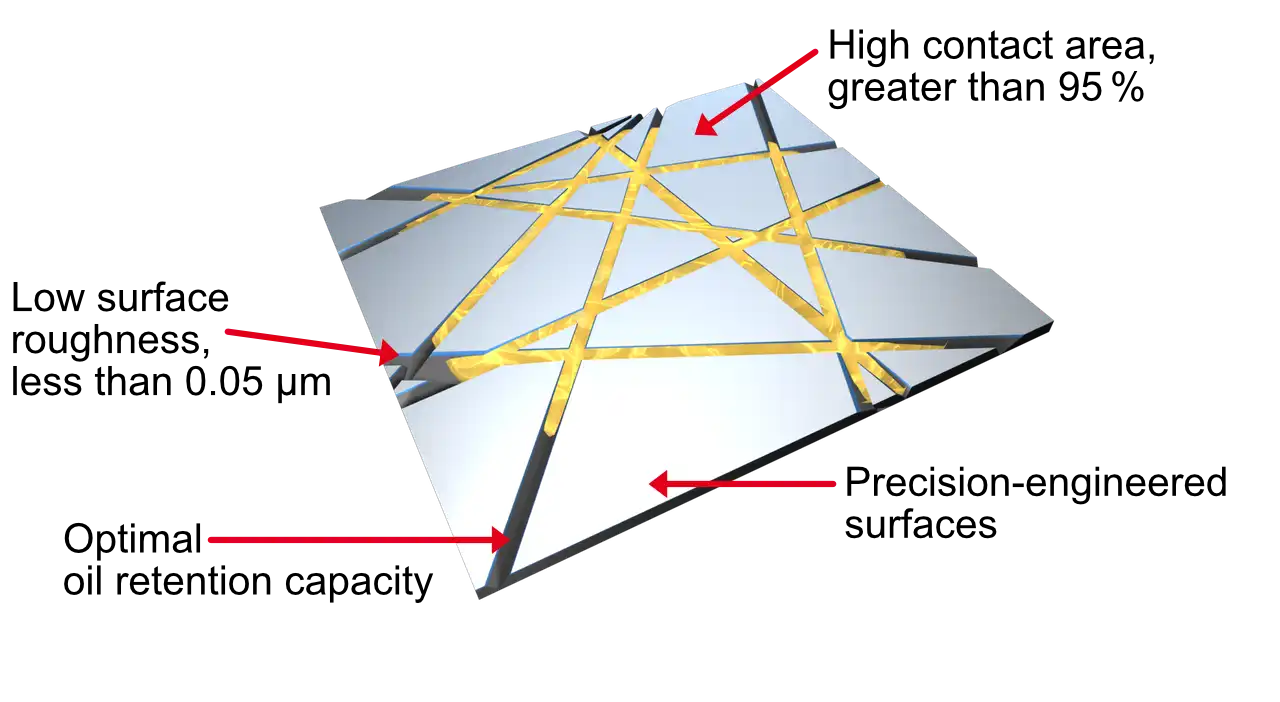
Components that have been processed using superfinishing exhibit an optimized surface structure. The process creates a plateau-like surface with defined, intersecting grooves. This structure improves the fit between interacting components while also providing sufficient volume to retain lubricants. As a result, the tribological properties of the surface are significantly enhanced.
A key benefit of such optimized surfaces is reduced wear. In modern components—such as those used in engines or transmissions—the lower surface roughness allows parts to run in more quickly and evenly. In many cases, this eliminates the need for the lengthy break-in periods that were previously required, as well as early oil changes after initial operating hours.
In addition, reduced friction between component pairs leads to lower noise levels. This is particularly important for high-speed rotating components such as rolling bearings or engine parts, where even small differences in surface structure can affect running behavior and noise generation.
Another advantage is reduced energy consumption. When friction is lowered, less energy is lost as heat. Instead, a greater portion of the input energy can be used directly for motion. In this way, superfinishing helps improve the efficiency of technical systems and reduce overall energy consumption.
The superfinishing process is generally suitable for all materials that can be machined using tools with geometrically undefined cutting edges. This makes the process applicable to a wide range of different materials.
In addition to metals in various alloys and heat-treated conditions, many other materials can also be processed. These include ceramics, plastics, monocrystalline silicon, and various non-ferrous metals. Coated surfaces can likewise be optimized using the superfinishing process.
Thanks to its versatility, superfinishing can be used across a wide range of industries where high standards of surface quality and component performance are required.
The superfinishing process can be applied to a variety of workpiece geometries. Depending on the shape of the surface to be processed, different superfinishing methods are used, each specifically adapted to the respective geometry.
The most common applications include cylindrical surfaces, such as those found on shafts and axles. Raceway surfaces of ball bearings and other rolling-element bearing components can also be superfinished to improve their surface quality and functional performance.
In addition, the process is suitable for machining flat, concave, and convex surfaces. In these cases, cross-hatch superfinishing is often used, where rotating tools create a characteristic cross-hatch pattern on the surface.
Spherical surfaces can also be processed using the superfinishing method. This versatility allows a wide range of components with different geometric requirements to be optimized with regard to their surface structure and performance characteristics.
Various superfinishing methods are used to process cylindrical surfaces, depending on the specific workpiece geometry. One commonly used technique is plunge-cut superfinishing. In this process, the tool is brought into contact with the area to be machined while the workpiece is mounted between centers, i.e., between the headstock and tailstock. This method is widely used in the automotive industry for components such as valve stems, crankshafts, and camshafts. Shafts used in modern manual, automatic, and CVT transmissions are also superfinished in this way to optimize their surfaces for the high loads encountered during operation.
Another widely used method is centerless through-feed superfinishing. In this process, the workpieces are rotated by two transport rollers moving in the same direction and are fed continuously beneath the oscillating tool. During this pass, the surfaces are successively processed using tools of increasing fineness. This method is commonly applied to rolling elements used in modern rolling bearings, where surface quality is critical to achieving superior friction and bearing performance.
In addition, certain applications involve mounting workpieces between centers or in a chuck while the tool moves along the surface to be processed. Typical examples include gear rods, piston rods, and work rolls, where precise surface finishing is essential for optimal performance.
Through-feed superfinishing offers significant advantages, particularly in high-volume production environments. While plunge-cut superfinishing processes each workpiece individually, through-feed superfinishing continuously feeds components beneath the tool. This allows multiple workpieces to be processed in succession without interruption, resulting in highly efficient and cost-effective manufacturing.
Another key advantage is the continuous material flow. The workpieces are rotated by transport rollers while simultaneously moving beneath the oscillating tool. During this process, they can be machined using a sequence of increasingly fine finishing tools, enabling the surface to be refined step by step.
The method is particularly well suited for components with simple cylindrical geometries and for parts manufactured in large quantities. Typical examples include rolling elements used in modern rolling bearings. These components require exceptionally high standards of surface quality to achieve optimal friction and bearing performance, which can be reliably attained through the through-feed superfinishing process.
Are you looking for a flexible, modular and economical solution for your manufacturing processes?


